A Board Leadership Pipeline Should Exist Before You Need It
Board succession is not only about filling vacancies. It is about preparing people to lead.
Over the years, I saw two very different kinds of board succession.
One involved an unexpected vacancy. A board member passed away during the term. There would have been no way to plan for when that particular seat would become vacant. But the board was not starting from zero. Through its recruitment work, it already had relationships with prospective board candidates who had been considered and could potentially meet the organization's needs.
The circumstances were difficult and unexpected. The vacancy was not.
That distinction stayed with me.
A Candidate Pool Creates Options
Board recruitment is often treated as something that begins when a seat needs to be filled. My experience taught me the value of thinking about it differently.
A strong prospective candidate pipeline gives a board people it already knows something about. Their experience, perspective and potential contribution can be considered before a vacancy creates urgency.
That does not mean the next board member should be predetermined. The board's needs may have changed. The organization's strategy may have changed. A different candidate may ultimately be the right choice.
But having a thoughtful pipeline means the conversation can begin from preparation rather than scarcity.
NACD recommends a forward-looking approach to board composition, including consideration of future strategic needs, committee-specific requirements and the readiness of potential committee-chair successors.¹
That raises a second succession question that I came to appreciate later.
What about the leaders already sitting around the table?
The Pipeline Does Not End With Recruitment
Finding strong board members is only the beginning.
Over time, board members gain institutional knowledge, understand the organization's challenges more deeply and develop their own ways of contributing. Some will eventually be asked to take on greater responsibility as committee chairs, officers or board leaders.
But being an effective board member and being prepared to lead other members are not necessarily the same thing.
I saw this firsthand when several experienced members left the board during the same period, including a committee chair.
There were capable people remaining. The board could elect another chair, and ultimately they did.
What was missing was something more intentional. We had not deliberately prepared another committee member to step naturally into that leadership responsibility.
The distinction matters.
A board can have someone who can fill a role without having someone who has been prepared for it.
Leadership Development Belongs in Board Succession
This is one place where my experience aligns closely with broader governance guidance.
BoardSource recommends ongoing attention to officer succession and identifies committee-chair service as an important leadership-development opportunity.² NACD similarly recommends that boards identify potential successors and develop future leaders through mentorship, training and exposure to leadership roles.³
Yet the practice is far from universal.
NACD's 2024 survey of public-company directors found that only 29 percent of responding boards had developed or reviewed a formal board leadership succession plan during the prior 12 months. Even fewer, 27 percent, reported that current committee chairs served as mentors to potential successors.⁴
The numbers are striking because most respondents also believed current board members could step into leadership roles if a board or committee chair left. Confidence in available talent is valuable. Intentional preparation is different.
That suggests an opportunity to think about board succession as more than replacement planning.
It can be leadership development.
Think of Succession as a Pipeline
Instead of asking only:
Who could fill this seat?
Boards might also ask:
Who are we preparing for what comes next?
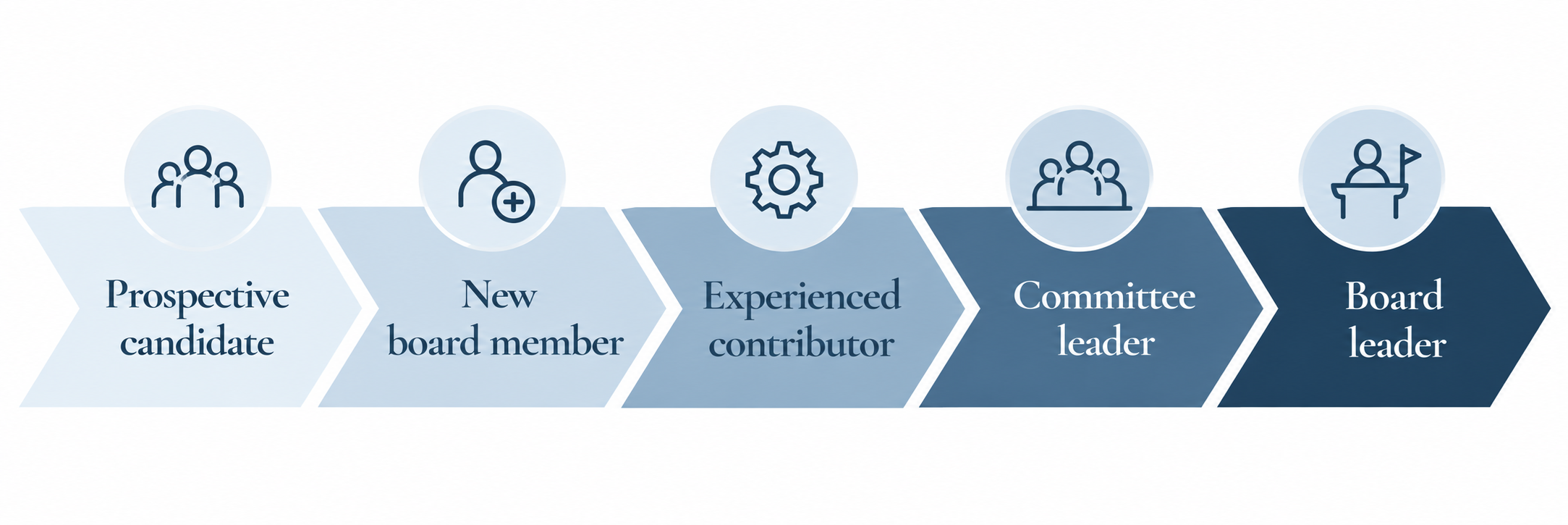
Not every board member will move through every stage. Nor should leadership roles be promised years in advance. Board composition changes. Organizational needs evolve. Individual interests and capacity change.
The purpose of a pipeline is not to predetermine succession. It is to make development intentional.
That could mean giving a future committee leader opportunities to facilitate discussion, participate in agenda development or work closely with the current chair. It could mean mentorship between experienced and newer board members. It could mean periodically discussing leadership interests and readiness as part of board evaluation and development.
Most importantly, it means noticing potential before a vacancy forces the conversation.
Five Questions Boards Can Ask Now
1 | Do we maintain relationships with credible prospective candidates before a vacancy occurs?
2 | Are we looking at future board and committee needs, not only today's composition?
3 | Which current board members could step into committee or board leadership, and what development would help them be ready?
4 | Are current chairs creating opportunities for others to lead, facilitate and gain exposure to the work?
5 | If an unexpected vacancy occurred tomorrow, would we be choosing from prepared options or simply reacting to the moment?
Preparation Creates Choice
The lesson I have taken from both experiences is simple.
A board cannot predict when every vacancy will occur. It can decide whether it will be prepared when one does.
Maintaining relationships with prospective candidates creates options outside the board. Developing board members already serving creates readiness inside it.
Both matter.
Because board succession should not begin with the question:
Who can take this role now?
A stronger question is:
What are we doing now so that someone will be ready when the organization needs them?
Sources
1. National Association of Corporate Directors. Multiyear Board Succession Planning Matrix. NACD recommends a forward-looking view of board composition and committee-specific succession needs.
2. BoardSource. Board Officer Succession Planning. BoardSource recommends ongoing officer succession planning and identifies committee-chair service as a leadership-development opportunity.
3. National Association of Corporate Directors. Succession Planning for Board and Committee Leaders. November 14, 2024. Guidance includes identifying successors and developing future leaders through mentorship, training and exposure to roles.
4. National Association of Corporate Directors. 2024 Public Company Board Practices and Oversight Survey: Board Leadership Succession Planning. August 28, 2024.
About Governance Insights
Governance Insights is a series by Sherri L. Morris exploring the practical work behind board effectiveness, executive decision-making, leadership transitions and organizational readiness.
Sherri L. Morris | Executive Leadership Partner